
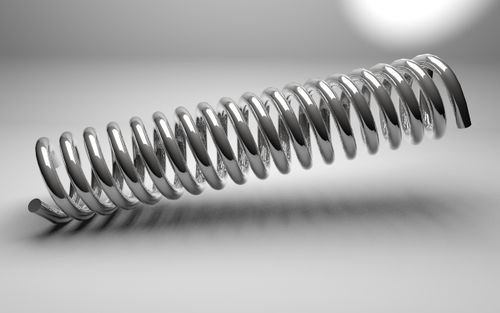
Every garage door has springs doing the heavy lifting, and there are exactly two kinds: torsion and extension. They look different, work differently, and cost different amounts to replace — so knowing which type hangs over your garage is genuinely useful the next time something goes wrong or you’re getting a quote. Here’s how to identify yours in about thirty seconds, and what the differences actually mean for you.
How to tell which type you have
Stand inside your garage and look at the door. If you see one or two tightly wound coils mounted on a horizontal metal shaft directly above the door opening (on the wall header), you have torsion springs. You’ll also notice cable drums at each end of the shaft. If instead you see long springs running parallel to the horizontal tracks — one on each side of the garage, stretching from the front toward the back — you have extension springs, usually with a pulley at each end. That’s the whole identification test. Torsion lives above the door; extension lives alongside the tracks.
How torsion springs work
A torsion spring stores energy as torque — twisting force. When the door closes, the spring winds tighter; when it opens, the spring unwinds and that stored twist helps lift the door. The spring sits on a stationary shaft, and as it turns, cable drums at each end wind the lift cables evenly. Because both sides of the door are driven by the same shaft, torsion systems lift smoothly and stay balanced. Most modern residential doors in Coppell use torsion springs, and heavier double doors often use two of them (a dual-spring setup) so the load is shared.
How extension springs work
Extension springs store energy as stretch. They’re mounted above the horizontal tracks and extend as the door closes, then contract to help pull the door open. Pulleys and cables do the actual lifting work at each side. Extension systems are simpler and were the standard on older and lighter doors. One critical detail: extension springs should always have a safety cable running through the center of each spring, anchored to the track. If the spring snaps, the safety cable catches it instead of letting it fly across the garage.
Which type is safer?
Torsion springs are generally considered the safer design because the spring is contained on its shaft — when one breaks, it usually just stays put with a visible gap in the coil, and the door simply becomes very heavy. Extension springs under tension can become projectiles if they break without a safety cable, which is why that cable is non-negotiable. That said, both types store an enormous amount of energy, and both can cause serious injury if mishandled. “Safer design” never means “safe to DIY” — spring work belongs to trained technicians either way.
How long does each type last?
Both types are rated in cycles — one cycle is a full open-and-close. Standard springs of either type are rated for about 10,000 cycles. For a Coppell household that opens the door four times a day, that’s roughly seven years. High-cycle springs (20,000 to 30,000 cycles) are available for both types and make sense if your garage is the main entrance to the house. Texas heat and humidity can shorten spring life slightly by accelerating corrosion, which is why a light coat of silicone-based lubricant once or twice a year is worth the two minutes it takes.
What does replacement cost?
Torsion spring replacement typically runs a bit higher than extension because the job involves carefully winding the new spring to the correct tension — a precise, skilled task. In the Coppell area, torsion replacement generally falls in the roughly $180 to $350 range, while extension replacement is often in the roughly $150 to $280 range, depending on door size and spring quality. Dual-spring torsion setups cost more than singles. These are typical ranges, not quotes — the exact price depends on your specific door.
Can you convert from extension to torsion?
Yes, and some homeowners do it when replacing an aging extension system. A torsion conversion gives smoother, more balanced operation and eliminates the projectile risk of extension springs. It requires new hardware (shaft, drums, brackets, springs), so it costs more than a like-for-like extension replacement. Whether it’s worth it depends on your door’s weight, age, and how long you plan to stay in the home — a technician can walk you through the trade-offs for your specific setup.
What to tell your technician
When you call for service, just say which type you have (“torsion, single spring” or “extension springs on the sides”) and whether you see a visible gap in any coil. That one sentence helps the technician bring the right parts on the first visit, which is often the difference between a same-visit fix and a return trip.
Not sure what you’re looking at, or spotted a gap in a coil? Call Coppell Garage Door Experts at (945) 404-0050 — we’ll identify your spring type, check its condition, and give you a straight answer on what it needs.
Garage Door Services at a Glance
| Service | Typical range* |
|---|---|
| Spring replacement | $180 – $350 |
| Opener repair | $150 – $300 |
| Cable replacement | $150 – $250 |
| Roller replacement | $150 – $300 |
| Maintenance tune-up | $99 – $179 |
*Typical Coppell-area ranges.